
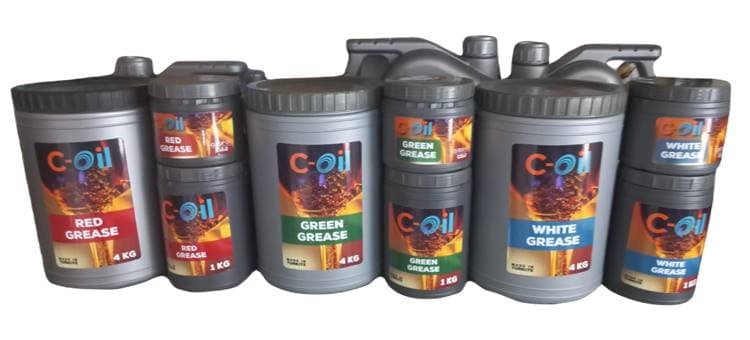
Oil flows away; grease stays put. The right grease has the correct consistency (NLGI), thickener type, base oil viscosity and temperature range. Bearings, chassis and high-temperature applications.
Grease is really a base oil held in place by a thickener (a soap): the oil does the lubricating, the soap acts like a sponge that keeps the oil where it is put. That is why grease is used in open bearings where oil would run out, on vertical shafts, at chassis points exposed to dust and water, and where sealing is difficult. Choosing the right grease comes down to four headings: consistency, thickener type, base oil and temperature.
Consistency: the NLGI grade
Grease stiffness is given by the NLGI number: 000 and 00 are nearly fluid (enclosed gearboxes), 0 and 1 are soft (centralised lubrication, low temperature), 2 is the most common grade (general bearing lubrication), and 3 is stiffer (vertical shafts, high temperature, good sealing). The wrong consistency: too soft and the grease is thrown out of the bearing; too stiff and it cannot reach the bearing core. For most general use, NLGI 2 is the right starting point.
Thickener (soap) type
- Lithium: the most common, multi-purpose; good water resistance and mechanical stability, medium-high temperature.
- Lithium complex: lithium with improved high-temperature and load capacity; higher dropping point.
- Calcium / calcium sulphonate: excellent water resistance and corrosion protection; wet and salty environments, marine.
- Polyurea: long life and high temperature; electric-motor bearings, life-lubricated applications.
Base oil viscosity
The oil inside the grease also has a viscosity grade, and it does the actual lubricating. Small, fast-turning bearings want a low-viscosity base oil (ISO VG 68–150); slow, heavily loaded large bearings want a high-viscosity base oil (ISO VG 220–460). Even with the same NLGI, the wrong base oil leaves lubrication short; check the "base oil viscosity" line in the data sheet.
Dropping point and operating temperature
The dropping point is the temperature at which grease turns fluid; the operating temperature should stay at least 30–50 °C below it. Lithium grease offers a dropping point around 180 °C, lithium complex around 260 °C, polyurea and calcium sulphonate higher still. In high-temperature use it is not only the dropping point that matters but the grease life at that temperature; the re-lubrication interval shortens as temperature rises.
A warning on mixing greases
Mixing greases with different thickener types can break the consistency: the mix may soften and run, or harden and stop releasing oil. Lithium and calcium are often compatible, but polyurea is incompatible with many soaps. When changing brand or thickener type, clean the bearing and refill with the new grease, then re-lubricate frequently for the first few intervals until the old grease is purged.
In short
The right grease has the NLGI consistency the application needs (2 for most bearings), the thickener type the environment calls for (usually lithium/lithium complex, calcium sulphonate in wet conditions), a base oil viscosity matched to bearing speed and load, and a dropping point safely above the operating temperature. C-Oil greases are produced in a range of thickeners and NLGI grades; we can work out the right product for your application data together.