
Antifreeze does more than stop freezing; it raises the boiling point, holds off corrosion and lubricates the water pump. The IAT, OAT and HOAT difference, the right concentration, mixing risk and change interval.
Coolant is the fluid that carries engine heat to the radiator, and it does four jobs: it stops freezing in winter, raises the boiling point in summer, protects the metals in the system from corrosion and lubricates the water-pump seal. What does those four jobs is not the glycol in the water but the corrosion-inhibitor additive package in it. So antifreeze should be chosen by its chemistry and the vehicle approval, not by its colour.
What IAT, OAT and HOAT are
- IAT (inorganic): silicate and phosphate based, older systems; protection is effective but the additive depletes fast, changed every 2 years.
- OAT (organic): organic acid salts, long life (5 years / ~250,000 km); no silicate/phosphate, standard on many modern vehicles.
- HOAT / Lobrid: OAT plus a small amount of silicate; combines fast surface protection with long life, the type many European vehicles require.
Why colour is not reliable
Antifreeze colours come from dye and vary between makers: the same green can be two different chemistries, and the same chemistry can be sold in different colours. The assumption that "same colour means same fluid" is wrong, and when two incompatible fluids mix the additives can drop out, gel can form and the radiator and heater core can block. The right source is the coolant specification in the owner's manual (e.g. VW G12++/G13, MB 325.x, not "red" or "blue").
Concentration: how much water?
Concentrated antifreeze is not used neat; it is diluted with demineralised water. A typical ratio is 50% antifreeze / 50% water by volume, giving roughly -37 °C freeze and +108 °C (pressurised) boil protection. In cold climates it can go to 60%; above 70% heat transfer drops and the freeze point rises again. Do not use tap water: scale and chloride cause corrosion and deposits. Ready-mix products are already diluted to the right ratio.
Change interval and checks
OAT and HOAT fluids last 5 years / ~250,000 km, IAT fluids 2 years; the vehicle maker's interval governs. At an interim check, the freeze point is read with a refractometer and the pH and colour inspected: fluid that has turned brown, gone cloudy or holds sediment has reached the end of its life. At a change the system is fully drained and flushed if needed; only topping up risks mixing old and new chemistry.
In short
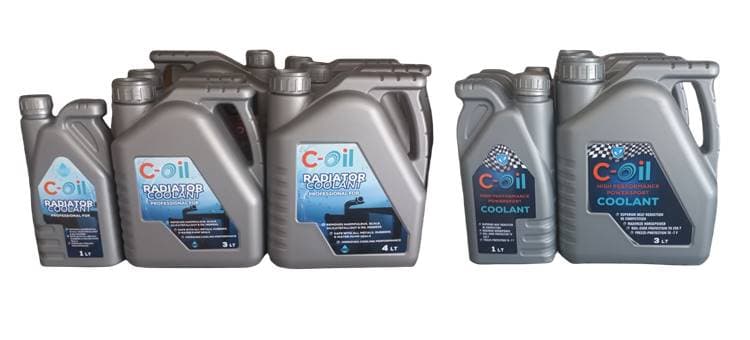
Antifreeze is decided by the specification in the owner's manual, not by colour. Choose the right chemistry, dilute it with demineralised water at the right ratio (usually 50/50), do not mix fluid types and change it within the maker's interval. C-Oil antifreeze and engine coolants are produced in different chemistries (IAT, OAT, HOAT) and in concentrate and ready-mix form; we can work out the right type for your vehicle together.